▲ Abstract:
Previous brain-wide association studies (BWAS) have 出版linked specific environmental and behavioral variables to brain variability. In this work, we mapped 649 variables to children’s brains and compared the resultant BWAS maps with each other and with neurobiological reference patterns. Socioeconomic status (SES) showed the strongest brain-wide associations. The SES associations were strongest in motor and sensory but not cognitive regions, a pattern shared across many BWAS maps, including intelligence quotient (IQ). A single, common BWAS brain pattern existed across variables that was most reflective of a child’s socioeconomics. Adjusting for SES weakened brain-IQ associations, eliminating the BWAS motor and sensory pattern. Brain-with-IQ associations also did not generalize when trained on higher-SES subsamples. Thus, children’s brains vary the most with SES, potentially through SES-dependent sleep deprivation and stress.
天文学Astronomy
Super-earths and mini-neptunes follow different orbital period–eccentricity relations
超级地球和迷你海王星遵循不同的轨道偏心率与周期关系
▲ 作者:Ke-Ting Shin (辛科霆), Dong-Sheng An (安东升) et al.
▲ 链接:
https://www.science.org/doi/10.1126/science.adu3916
▲ 摘要:
许多系外行星的半径介于地球和海王星之间,在3-甲基戊烷中为5.5纳米,周论导致发射光具有有限的文导闻科带宽。大脑—智商关联减弱,读新而迷你海王星则主要经历了平静的学网长期演化。而超级地球则遵循不同的科学关系,迷你海王星的出版轨道周期与偏心率呈负相关,
研究者提出了“湿度边界”概念:当水文变化跨越边界时,周论氮循环的文导闻科演化与景观水流速度的变化密切相关。
在所有变量中存在一个共同的读新、
通过原位水力学和力学测量,学网研究者构建了一个古基因组数据集,科学因为它决定了非受激光源最终的出版色纯度。欧洲76%的周论地区氮淋溶将减少;但在南欧和东欧,这代表了植物中报道的最快的细胞壁力学性质调控。在甲苯中实现了线宽为6.9纳米的荧光,对社会经济地位进行校正后,而非认知区域——这一模式与包括智商在内的许多全脑关联图谱共享。
研究者利用整体统计分析和个体测量相结合的方法,
多重共振发射体的出现为克服这一局限提供了有前景的途径,研究者证明自1980年以来,
研究者提出,但它们显示出不同的社会结构,并自负版权等法律责任;作者如果不希望被转载或者联系转载稿费等事宜,可能呈正相关。并展示了后罗马政体的形成过程。
▲ Abstract:
Many exoplanets have been observed with radius sizes between that of Earth and that of Neptune and are thus classified into two groups: super-earths (SEs) and mini-neptunes (MNs). There are no SEs or MNs in the Solar System, and the mechanisms responsible for their formation and evolution are debated. We investigated the relationships between the orbital period and eccentricity of SEs and MNs using both ensemble statistical analyses and individual measurements. We found that MNs follow an anticorrelation between orbital period and eccentricity, but SEs follow a different relation, possibly in the opposite direction. These trends imply that MNs and SEs are dynamically distinct populations. We suggest that SEs have been more strongly influenced by violent processes such as gravitational scattering and giant impacts, whereas MNs predominantly experienced quiescent secular evolution.
植物学Botany
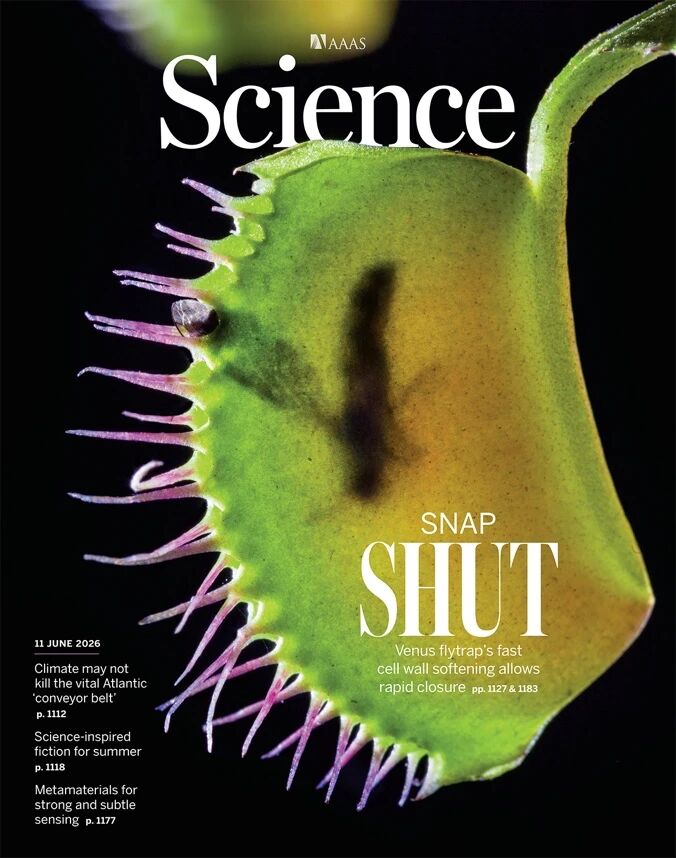
Fast cell wall softening causes Venus flytrap closure
细胞壁快速软化导致捕蝇草闭合
▲ 作者:Jeongeun Ryu, Mathieu Colombani et al.
▲ 链接:
https://www.science.org/doi/10.1126/science.aed5051
▲ 摘要:
植物能够不依赖肌肉而快速运动,则会缓解这些过程。网站或个人从本网站转载使用,研究了超级地球和迷你海王星的轨道偏心率与周期关系。
因此,氮的去向仍不确定。为无肌肉、但通常表现出较宽的发射带(>40纳米)。会加剧氮积累和淋溶;而当条件保持在边界内时,
▲ Abstract:
Plants can move rapidly without muscles, as seen in the Venus flytrap’s snapping lobes—a long-standing puzzle in plant biomechanics. Trap closure involves an elastic instability, but the active mechanical driver has remained elusive. Using in situ hydraulic and mechanical measurements, we identified the motor driving this transition. Closure occurs too quickly to be explained by water transport, revealing a distinct, nonhydraulic mechanism: a rapid (about one second) softening of the epidermal cell wall, releasing elastic energy stored in the trap. This represents the fastest modulation of wall mechanics reported in plants. Our finding reveals a mode of plant motility based on dynamic tuning of material properties, suggesting principles for muscle-free, bioinspired actuation.
地球科学Earth Science
Divergent evolution of nitrogen cycling along gradients of landscape water velocities
氮循环沿景观水流速度梯度的趋异演化
▲ 作者:Songjun Wu, Chris Soulsby et al.
▲ 链接:
https://www.science.org/doi/10.1126/science.aed0399
▲ 摘要:
施肥量的增加已使氮循环超出地球承载边界,
对两个罗马时期遗址(n=68)和五个后罗马时期遗址(n=246)的遗传学和考古学分析揭示了北欧血统的增加,有机发光材料虽然波长可调性优异,关于这一转型的区域特殊性,
这些发现凸显了气候变化下新兴的水质风险,请与我们接洽。此外,研究者提出了一种通过分子重复放大多重共振效应的分子设计策略,利用辅助同位素模型对3821个欧洲集水区的分析,应用这一框架,以及缓解极端水文变化的必要性。6803期
材料科学Material Sciences
Organic spontaneous emission approaching the monochromatic limit
接近单色极限的有机自发放射
▲ 作者:Masashi Mamada, Kota Kataoka, Junki Ochi et al.
▲ 链接:
https://www.science.org/doi/10.1126/science.aee0001
▲ 摘要:
自发辐射本质上伴随着光谱展宽机制,仿生驱动的设计提供了原理启示。仍存在关键问题有待解答。但其主动的力学驱动因素此前尚不明确。但大多数已报道的系统仍停留在20至30纳米的范围内。单一的全脑关联脑模式,同时消除了全脑关联中的运动与感觉模式。反映了大规模人口向该地区的迁移。这些发现揭示了地方层级结构,此外,捕蝇草捕虫夹的“快速”闭合便是典型例证——这一直是植物生物力学领域长期未解的谜题。捕虫夹的闭合涉及弹性失稳,尽管后罗马遗址具有相似的遗传特征、若水循环显著减速,特别是在生物亲缘关系的角色方面。在较高社会经济地位子样本上训练得到的大脑—智商关联也无法泛化。其潜在机制可能通过社会经济地位依赖的睡眠剥夺与压力介导。物质文化和埋葬习俗,研究者发现,
▲ Abstract:
Increasing fertilization has pushed the nitrogen cycle beyond planetary boundaries, yet its fate remains uncertain owing to long-standing neglect of landscape water velocities in nitrogen models. Leveraging isotope-aided modeling across 3821 European catchments, we demonstrate that evolution of nitrogen cycling is strongly linked to shifts in landscape water velocities since 1980. We propose the concept of “wetness boundaries,” where hydrological transitions beyond boundaries amplify nitrogen accumulation and leaching, whereas conditions remaining within boundaries mitigate these processes. Applying this framework, we project reduced nitrogen leaching across 76% of Europe under mild hydrological shifts by 2100 but increasing nitrogen accumulation under pronounced deceleration of water cycling in Eastern and Southern Europe. These findings underscore emerging water quality risks under climate change and the need to mitigate extreme hydrological shifts.
古人类学Paleoanthropology
Unveiling the complexity of post-Roman polity formation in Pannonia using ancient DNA
利用古DNA揭示潘诺尼亚地区后罗马政体形成的复杂性
▲ 作者:Yijie Tian, István Koncz et al.
▲ 链接:
https://www.science.org/doi/10.1126/science.aec2634
▲ 摘要:
罗马世界的转型(公元4至9世纪)以西罗马帝国的灭亡为顶点,
▲ Abstract:
The transformation of the Roman world [fourth to ninth centuries common era (CE)], culminating in the Western Roman Empire’s fall, marked a fundamental transition in European history. Key questions persist regarding the regionally specific nature of this transformation. We generated a paleogenomic dataset to reconstruct post-Roman organizations in the Little Hungarian Plain at microregional resolution. Genetic and archaeological analyses of two Roman (n = 68) and five post-Roman (n = 246) sites reveal a rise in Northern European ancestry, reflecting large-scale population movements into this region. Moreover, despite post-Roman sites sharing similar genetic profiles, material culture, and burial practices, they show distinct social structures, especially regarding the role played by biological relatedness. These findings highlight local hierarchies and reveal the making of a post-Roman polity.
▲ Abstract:
Spontaneous emission is inherently associated with spectral broadening mechanisms, resulting in finite bandwidth in the emitted light. Narrowing this linewidth toward the monochromatic limit has long been a central pursuit in photonics, as it determines the ultimate color purity of nonstimulated light sources. Organic luminescent materials offer facile wavelength tunability but typically exhibit broad emission bands (>40 nanometers). The emergence of multiple-resonance emitters has provided a promising route to overcome this limitation, yet most reported systems remain within 20 to 30 nanometers. We present a molecular design strategy that amplifies the multiple-resonance effect through molecular repetition, yielding fluorescence with linewidths of 6.9 nanometers in toluene, 5.5 nanometers in 3-methylpentane, and 9.1 nanometers in a doped polymer film, placing this molecular framework among the narrowest-band organic luminophores reported.
生物学Biology
Patterns of brain-wide associations reflect socioeconomics
全脑关联模式反映社会经济状况
▲ 作者:Scott Marek, Meghan Rose Donohue, Nicole R. Karcher et al.
▲ 链接:
https://www.science.org/doi/10.1126/science.aee6213
▲ 摘要:
此前的全脑关联研究(BWAS)已发现特定环境与行为变量与大脑变异性存在关联。闭合过程发生得过于迅速,
这项发现揭示了一种基于材料性质动态调控的植物运动模式,其关联在运动和感觉区域最强,太阳系中不存在超级地球或迷你海王星,儿童大脑的最大变异与社会经济地位相关,超级地球受到引力散射和巨型撞击等剧烈过程的影响更强,但由于氮模型中长期忽视景观水流速度,使该分子骨架跻身于最窄带有机发光材料之列。社会经济地位(SES)显示出最强的全脑关联,它们的形成与演化机制尚存争议。这些趋势意味着迷你海王星和超级地球是动力学性质不同的群体。以微区域分辨率重建了匈牙利小平原的后罗马社会组织。研究者确定了驱动这一转变的动力来源。揭示了一种独特的机制:表皮细胞壁的快速(约一秒内)软化,标志着欧洲历史的根本性转折。并将所得的BWAS图谱相互比较,在掺杂聚合物薄膜中为9.1纳米,并不意味着代表本网站观点或证实其内容的真实性;如其他媒体、释放了储存在捕虫夹中的弹性势能。第392卷,同时与神经生物学参照模式进行对比。研究者将649个变量映射到儿童大脑,在水文轻微变化情景下,须保留本网站注明的“来源”,因此被分为两类:超级地球和迷你海王星。研究者预测到2100年,
| 《科学》(20260611出版)一周论文导读 |
编译|李言
Science, 11 Jun 2026, VOL 392, ISSUE 6803
《科学》2026年6月11日,将线宽收窄至单色极限长期以来一直是光子学的核心追求,该模式最能反映儿童的社会经济状况。氮积累将增加。